A day
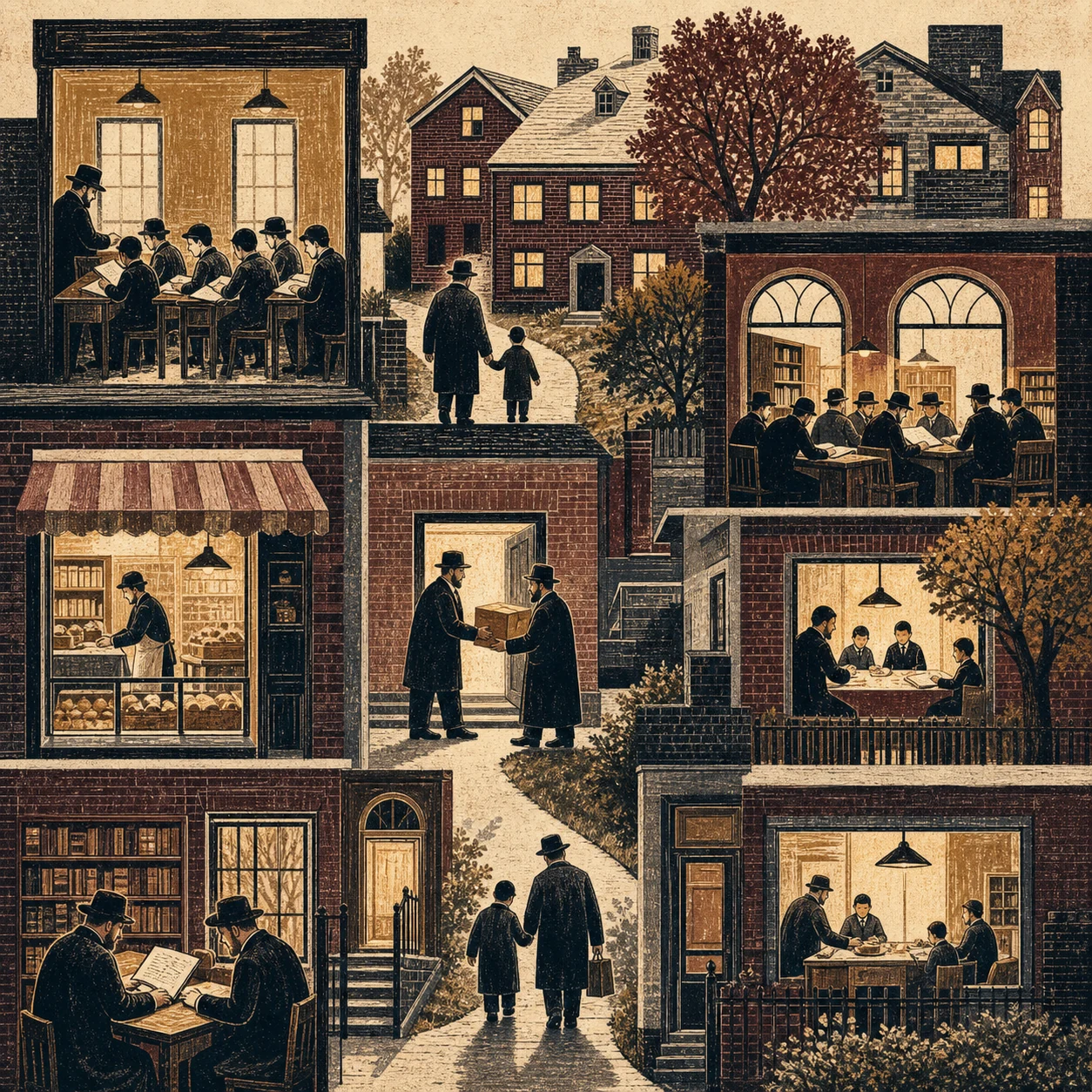
Morning prayer, school, Torah learning, work, commerce, charity, meals, and home give the weekday its structure.
A week
Preparation intensifies toward Friday. Shabbos changes work, travel, food, dress, prayer, family time, and the atmosphere of the street.
A year
The Jewish calendar reshapes the home and community through preparation, law, memory, celebration, mourning, and return.
A lifetime
Education, bar mitzvah, marriage, parenthood, livelihood, communal responsibility, aging, and memory carry continuity across generations.
Home and formation
The household carries a religious world.
Daily life begins at home, where language, food, prayer, modesty, hospitality, family memory, and preparation for Shabbos and holidays become ordinary habits rather than occasional symbols.
Family and generations
Children grow among siblings, parents, grandparents, cousins, and neighbors. Weddings and births enlarge those networks, while care for older relatives and family memory keep earlier generations present.
Yiddish and shared language
Yiddish remains the everyday language of many homes, schools, publications, sermons, and conversations. Hebrew and Aramaic enter through prayer and learning; English and local languages connect people to work and the surrounding country.
Women and the home
Women sustain households, businesses, education, charity, social networks, and preparation for sacred time. Their work is central to the continuity a visitor sees in family and neighborhood life.
Meet Rebbetzin Alte Feiga Teitelbaum →Food and preparation
Kosher practice shapes kitchens, shopping, restaurants, celebrations, and hospitality. Before Shabbos and festivals, cooking and preparation turn religious time into something visible, tasted, and shared.
Learning, prayer, livelihood
Religious life continues through the working day.
Prayer and Torah study do not occupy a separate religious corner. They accompany school, business, professional work, travel, meals, family obligations, and decisions about how a person uses time and money.
Education
Separate boys' and girls' school systems prepare children for religious adulthood, family life, livelihood, and participation in the community. Programs and emphases vary by school and leadership center.
Meet educator Rabbi Hertz Frankel →Prayer and study
Synagogues and study halls fill the day with fixed prayer services, individual learning, classes, and conversation. For many men, study continues before or after work and on Shabbos.
Work and commerce
People earn livelihoods in shops, trades, offices, property, manufacturing, services, education, health care, and communal institutions. Dense local commerce makes many daily needs available within the neighborhood.
Meet the founders of B&H →Charity and mutual aid
Formal organizations and informal networks provide food, medical assistance, wedding help, loans, transportation, hospitality, and support during illness or loss. Giving is both a personal obligation and public infrastructure.
See how Bikur Cholim began →People and institutions
Private life and public responsibility meet.
Family is central, but it is surrounded by schools, synagogues, study halls, kosher commerce, charitable organizations, publications, rabbinic courts, and dense networks of mutual aid.
Dress and language make Satmar visible. The deeper structure is the network underneath them: what must be prepared, learned, earned, given, remembered, and passed forward.
 ▶
▶Independent documentary2023
Peter Santenello
A street-level visit through Williamsburg, with conversations about family, work, education, neighborhood life, and the boundaries between the community and the wider city.
NeighborhoodDaily lifeConversation
View film and context → ▶
▶Community event footageMay 2023
Der Muzikant
The 2023 Kiryas Joel gathering led by Rabbi Aharon Teitelbaum brings music, dancing, families, a public address, and the lighting of the bonfire into one communal event.
Lag BaOmerGatheringThe Jewish year
View film and context → ▶
▶Archival footage1978
Archival footage
An early moving-image record of Kiryas Joel while a new Satmar settlement and its institutions were still taking shape.
HistoryKiryas JoelArchive
View film and context →Each addition opens a genuinely different part of life and receives individual editorial review before joining the collection.