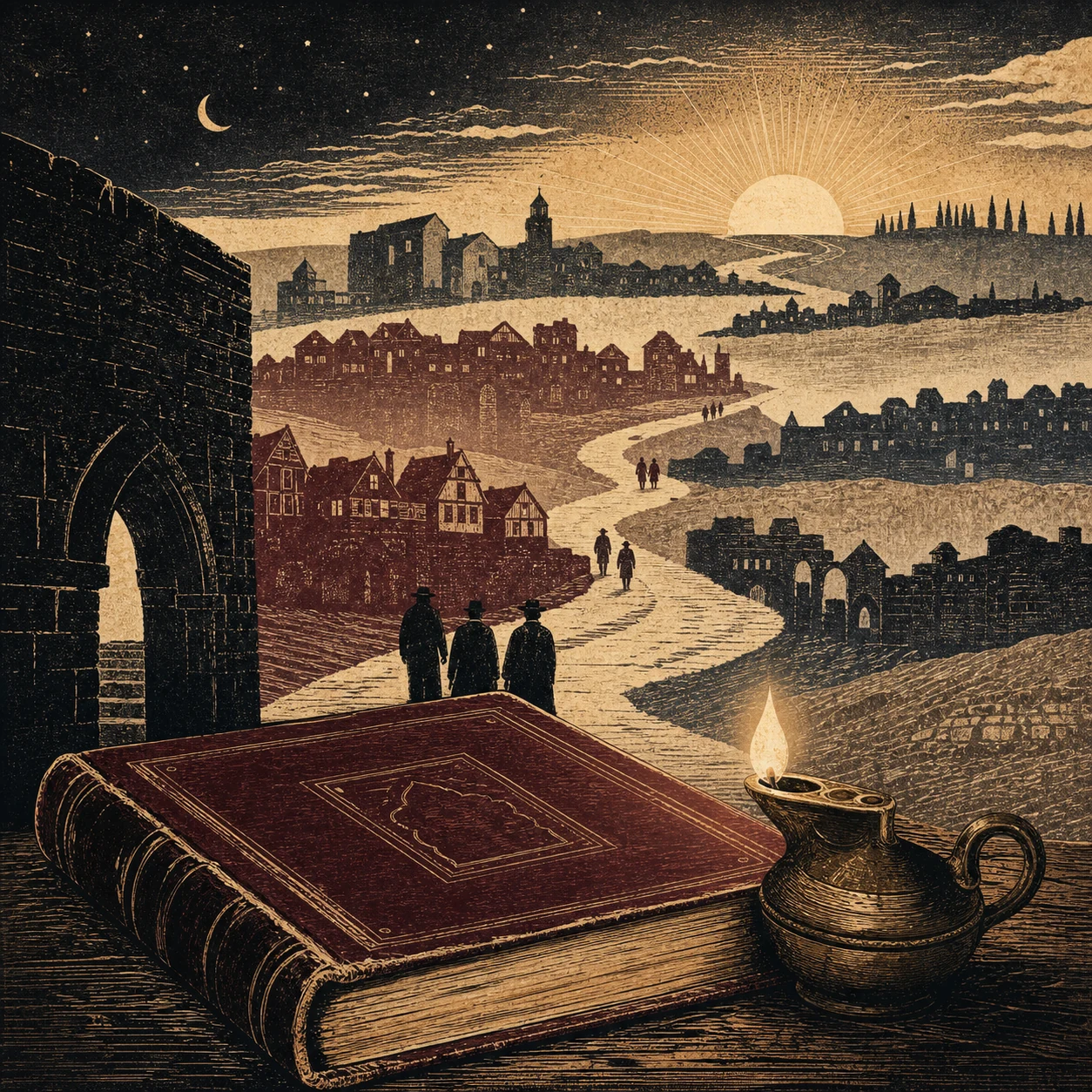
Satmar took shape in the Jewish world of Hungary and Transylvania, was devastated with that world during the Holocaust, and rebuilt communal life through families and institutions in the decades that followed.
A Hungarian and Carpathian inheritance
The religious culture later identified with Satmar belongs to the wider world of Hungarian and Transylvanian Orthodoxy and Hasidism. It developed amid intense debates over religious reform, communal boundaries, and the meaning of continuity.
Szatmar
In the scholarly account published by the YIVO Encyclopedia, Rabbi Yoel Teitelbaum founded the Satmar Hasidic court in Szatmár in 1928. The place name appears in Hungarian as Szatmárnémeti and today in Romanian as Satu Mare.
Destruction
After the German occupation of Hungary in March 1944, German and Hungarian authorities deported roughly 440,000 Jews in less than two months, mostly to Auschwitz-Birkenau. The Jewish world of Satu Mare and its surrounding region was devastated.
Williamsburg
After the war, Rabbi Yoel Teitelbaum and survivors established a new center in Williamsburg. Rebuilding joined congregational life with schools, charitable networks, publications, courts, businesses, and family life.
Kiryas Joel
Kiryas Joel developed in Orange County, New York, as a distinct municipality organized around Satmar communal life. It created physical room for expanding families and institutions while changing the relationship between enclave, government, and the wider public.
Many communities, living continuity
Contemporary Satmar includes major leadership centers in Williamsburg and Kiryas Joel, other communities in North America, Europe, and Eretz Yisrael, and substantial institutional and personal diversity.
A movement shaped by a leader
Rabbi Yoel Teitelbaum gave Satmar its form.
Satmar inherited a much older Hungarian and Transylvanian religious world. Rabbi Yoel Teitelbaum gathered those inheritances into a distinctive Hasidic court, communal discipline, and public religious outlook.
Rabbi Yoel came from the Sighet rabbinic dynasty and served communities before assuming leadership in Szatmár. His teaching joined Hasidic devotion with the strong boundaries of Hungarian Orthodoxy.
A court in Szatmár
From 1928, the city became the center of a growing court. Followers were joined by institutions, patterns of religious authority, and an approach to modern political and cultural change that would remain central after the war.
Destruction and survival
The European world was not transplanted intact.
The Holocaust destroyed families, congregations, schools, and towns across Hungary and the Carpathian region. Rabbi Yoel survived the deportations and eventually reached the United States; the community rebuilt among survivors carrying grief, memory, and fragments of institutions that had been lost.
Postwar Satmar became a new American community built by survivors, their children, and many families whose earlier affiliations had been elsewhere in the Hungarian Jewish world.
Rebuilding through institutions
Williamsburg became more than a congregation.
Schools, synagogues, rabbinic courts, charities, publications, food systems, businesses, and family networks made it possible to live an inherited religious life in New York. Yiddish became an especially important language of education and public continuity.
Rapid growth
Large families and expanding school systems transformed a survivor community into one of the world's largest Hasidic networks. New congregations and neighborhoods grew from Williamsburg across North America and beyond.
Kiryas Joel
Beginning in the 1970s, Kiryas Joel created a separate municipal setting for homes and institutions. Its growth made the scale of Satmar family and educational life visible in the physical form of a town.
Succession and the present
One inheritance, more than one leadership center.
Rabbi Yoel died in 1979 and was succeeded by his nephew, Rabbi Moshe Teitelbaum. After Rabbi Moshe's death in 2006, two major leadership centers formed around his sons Rabbi Aharon Teitelbaum and Rabbi Zalman Leib Teitelbaum.
Those centers sustain separate networks of congregations and institutions while sharing the Satmar name, much of the same inherited religious framework, and deep family and communal ties. Satmar today extends through Williamsburg, Kiryas Joel, Borough Park, Monsey, Montreal, London, Antwerp, Eretz Yisrael, and smaller communities and satellites. Its history is therefore not only a line of rebbes or dates; it is the continuing creation of homes, schools, charities, publications, livelihoods, and religious authority.